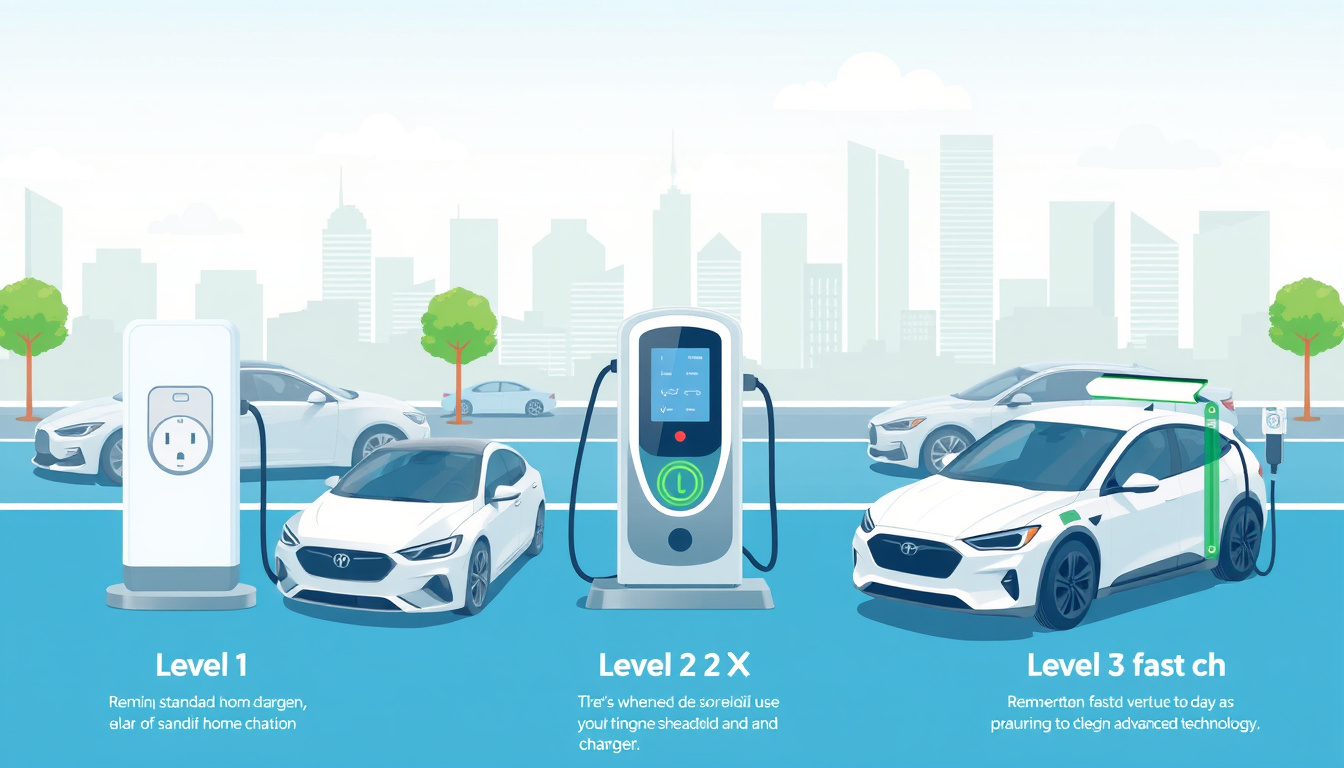
As electric vehicles (EVs) continue to gain popularity, understanding the different EV charging types becomes crucial for both new and current EV owners.
In this comprehensive guide, we will dive into the various EV charging types explained, specifically focusing on Level 1, Level 2, and Level 3 charging.
Whether you’re considering transitioning to an electric vehicle or simply want to stay informed, this article will provide you with valuable insights into the charging options available, their efficiencies, and how to optimally charge your EV.

Key Takeaways
- Level 1 charging uses a standard household outlet and is the slowest option for EV charging.
- Level 2 charging is faster and requires a dedicated home charging station or public charging infrastructure.
- Level 3 charging, or DC Fast Charging, provides the quickest charge and is often available at commercial charging stations.
- Charging speed and efficiency vary significantly among the three types, impacting overall EV ownership experience.
- Future trends suggest advancements in EV charging technology will enhance charging speed and accessibility for consumers.
Introduction to EV Charging Types
As electric vehicles (EVs) gain popularity, understanding the different EV charging types becomes essential for current and prospective owners.
EV charging types explained typically fall into three primary categories: Level 1, Level 2, and Level 3 charging.
Level 1 charging utilizes a standard 120-volt outlet, making it perfect for overnight home charging; however, it’s the slowest of the three options, adding about 4-5 miles of range per hour.
Level 2 charging, commonly found in residential and public charging stations, operates at 240 volts, providing a considerably quicker charge, adding approximately 25 miles of range per hour.
Finally, Level 3 charging, also known as DC fast charging, is designed for rapid charging needs, delivering up to 80% charge in just 30 minutes, making it ideal for long road trips.
Understanding these different EV charging types is critical for managing your vehicle’s range and optimizing your charging habits.
What is Level 1 Charging?
Level 1 charging is the simplest form of electric vehicle (EV) charging, and it operates using a standard household outlet, typically providing 120 volts of electricity.
This type of charging is ideal for overnight charging at home, as it utilizes a regular three-prong wall plug and doesn’t require specialized installation or equipment.
While Level 1 charging is convenient and accessible, it is generally the slowest method, offering about 4 to 5 miles of range per hour of charging, making it suitable for daily commuters or those with lower mileage needs.
Understanding EV charging types explained (Level 1/2/3) can help you determine the best option for your electric vehicle charging needs.
For instance, if you require quicker charging times, you might consider Level 2 or Level 3 charging solutions, which provide faster charging capabilities, but for those new to EV ownership, Level 1 remains an excellent starting point.
‘The greatest threat to our planet is the belief that someone else will save it.’ – Robert Swan

Exploring Level 2 Charging
In today’s evolving automotive landscape, understanding the various EV charging types is essential for both new and seasoned electric vehicle (EV) owners.
Among these, Level 2 charging is a popular choice that bridges the gap between home-based charging solutions and the high-speed opportunities provided by Level 3 charging.
Level 2 chargers typically operate at 240 volts, allowing for a significantly faster charge compared to Level 1 chargers, which operate on standard 120 volts.
This makes Level 2 charging ideal for home use, as it can replenish an EV’s battery in a few hours, making it a convenient option for overnight charging.
Moreover, many public charging stations also utilize Level 2 technology, providing a reliable and efficient way to charge while out and about.
Understanding EV charging types explained—from the slow trickle of Level 1 to the rapid charging capabilities of Level 3—empowers consumers to make informed decisions that best suit their driving habits and lifestyle.
Understanding Level 3 Charging (DC Fast Charging)
When it comes to EV charging types explained, understanding Level 3 Charging, also known as DC Fast Charging, is crucial for both new and seasoned electric vehicle (EV) owners.
Level 3 Charging offers the quickest recharge times, making it an ideal choice for EV drivers who are on the go.
Unlike Level 1 and Level 2 chargers that use alternating current (AC) to charge the vehicle, DC Fast Chargers convert the alternating current to direct current (DC) before it reaches the vehicle’s battery, allowing for a higher power output.
This means that Level 3 Charging can replenish an EV’s battery up to 80% in as little as 20-30 minutes, drastically reducing downtime during long journeys.
As more infrastructure is developed to support these rapid charging stations, understanding the benefits and applications of Level 3 Charging can help drivers make informed decisions about their charging habits and route planning.

Comparing Charging Speeds and Efficiency
When exploring the world of electric vehicles (EVs), understanding the different EV charging types explained (Level 1/2/3) is crucial for optimizing your charging experience.
Level 1 charging, utilizing a standard 120V outlet, is the most accessible option but offers the slowest charging speed, typically providing around 4 to 5 miles of range per hour.
This method is ideal for overnight charging at home but is not practical for rapid refueling.
In contrast, Level 2 charging, which operates on a 240V outlet, significantly enhances efficiency by delivering approximately 25 miles of range per hour, making it a popular choice for home installations and public charging stations alike.
Finally, there’s Level 3 charging, also known as DC fast charging, which offers lightning-fast service, adding up to 100 miles of range in just 30 minutes, perfect for road trips and quick stops.
By comparing these EV charging types explained, drivers can better choose the right charging solution for their lifestyle and travel needs.
Comprehensive Charging Resources
Understanding EV charging types is just the beginning. For a complete overview of charging infrastructure, installation, and best practices, explore our comprehensive electric vehicle charging guide that covers everything from home setup to public charging networks.
Before investing in charging equipment, use our electric car charging cost calculator to estimate your monthly charging expenses and understand the financial implications of different charging types and habits.
Expert Charging Guidance
According to Car and Driver’s electric car charging guide, understanding the differences between Level 1, Level 2, and Level 3 charging is fundamental to maximizing your EV ownership experience and ensuring you always have the range you need.
Who Should Use Level 1 Charging?
Level 1 charging works well for those seeking the most affordable electric cars with smaller batteries and shorter daily commutes. It’s an accessible starting point that requires no additional equipment investment.
If you’re new to electric vehicles, our pros and cons of electric cars guide helps you understand whether Level 1 charging capabilities align with your driving needs.
Level 2 Charging Installation
Installing a Level 2 charger at home is one of the most convenient upgrades for EV owners. Our electric vehicle charging guide provides detailed information about installation requirements, costs, and electrical considerations.
Solar-Powered Level 2 Charging
For sustainable home charging, consider pairing your Level 2 charger with electric car solar chargers to power your vehicle with renewable energy and reduce your carbon footprint even further.
Best Vehicles for DC Fast Charging
Not all electric vehicles support Level 3 charging. Higher-end models like the Tesla Model X and many electric SUVs are designed with DC fast charging capabilities for maximum convenience.
If performance and quick charging are priorities, explore our guide to the fastest electric cars, many of which feature advanced Level 3 charging capabilities.
Charging Infrastructure by Vehicle Type
Compact and Affordable EVs
Budget-friendly electric vehicles like the Hyundai Kona 2022 electric car and MG ZS EV typically support Level 1 and Level 2 charging, with select models offering Level 3 capabilities.
Electric SUVs and Charging
Electric SUVs often feature larger batteries requiring efficient charging. Explore Kia’s electric SUV models and the Volvo XC40 Recharge EV to understand their charging capabilities and requirements.
Premium Electric Vehicles
Luxury EVs from brands like BMW and Volvo typically offer comprehensive charging options including ultra-fast Level 3 charging for maximum convenience.
Battery Technology and Charging Compatibility
Understanding Battery Chemistry
Different battery technologies accept charging at different rates. Learn about EV battery technology to understand how battery chemistry affects charging speed and efficiency across all three charging levels.
Future Battery Technologies
Emerging battery technologies promise even faster charging capabilities:
- Lithium-Sulfur battery technology – potential for ultra-fast charging
- Sodium-Ion battery technology – improved charging cycles
- Flow battery technology – revolutionary charging approaches
- Nickel-Metal Hydride technology – proven charging reliability
Charging Considerations for Different Drivers
Family Charging Needs
Families with multiple drivers or larger vehicles like 7-seater electric cars often benefit from Level 2 home charging for overnight convenience, with Level 3 access for road trips.
Urban vs. Rural Charging
Your location significantly impacts charging type selection. Urban drivers typically have better access to Level 2 and Level 3 public charging, while rural drivers may rely more heavily on home Level 2 installations.
Cost Considerations for Each Charging Type
Different charging types have varying installation and operational costs. Use our charging cost calculator to compare electricity costs across all three charging levels based on your local utility rates.
For budget-conscious EV shoppers, explore affordable electric vehicles and understand how their charging capabilities align with your budget and infrastructure access.
Regional Charging Infrastructure
Global Charging Networks
Charging infrastructure availability varies by region. Explore our regional guides to understand local charging networks:
- Electric car infrastructure in the UK – extensive Level 2 and Level 3 networks
- Electric cars in Malaysia – growing charging infrastructure
- Electric cars globally – worldwide charging network developments
Finding Charging Stations
Locate charging stations and electric vehicle showrooms using our electric car showroom and charging locator to plan your charging strategy and vehicle purchase.
Environmental Impact of Charging Types
While all EV charging reduces emissions compared to gasoline, understanding how electric vehicles save the environment helps you make informed decisions about renewable energy integration with your charging setup.
Specific Vehicle Charging Recommendations
New EV Buyer Guidance
If you’re new to electric vehicles, start with our comprehensive resources:
- Brand new Hyundai electric models – affordable with Level 2 compatibility
- Kia electric cars – excellent charging versatility and value
- BYD Seal electric car – emerging options with modern charging tech
Premium Vehicles with Advanced Charging
For buyers seeking vehicles with the fastest charging capabilities, consider options from BMW’s electrical car lineup or the innovative Fisker Ocean, both designed for optimal Level 3 charging performance.
How much does it cost to install different charging types at home?
Installation costs vary significantly. Level 1 requires no installation (standard outlet), Level 2 typically costs $500-$2,000 for equipment and installation. Use our charging cost calculator to evaluate long-term costs. Check our comprehensive charging guide for detailed installation information.
Can I use solar panels to power my EV charging?
Yes! Learn about electric car solar chargers and how to integrate renewable energy with your Level 1 or Level 2 home charging setup for maximum sustainability and cost savings.
Which electric vehicles support Level 3 charging?
Most modern EVs support Level 3 charging, including the Tesla Model X, Kia electric SUVs, Hyundai Kona, and premium options from BMW and Volvo.
What charging type is best for daily commuting?
For daily commuting, Level 2 home charging is typically ideal, providing overnight charging convenience. Learn more about affordable electric vehicles and their charging capabilities to match your commuting needs.
How does battery technology affect charging speed?
Battery chemistry significantly impacts charging capabilities. Explore our guides on EV battery technology and emerging technologies like Lithium-Sulfur and Sodium-Ion batteries to understand future charging improvements.
Where can I find public Level 2 and Level 3 charging stations?
Use our charging station locator to find public charging infrastructure. Also check regional guides like UK electric car infrastructure for location-specific information.
Are there environmental benefits to different charging types?
All EV charging reduces emissions compared to gasoline vehicles. Learn more about how electric vehicles save the environment, and maximize benefits by using solar charging with renewable energy.
What should beginners know about EV charging?
New to electric vehicles? Understanding charging types is crucial. Review the pros and cons of electric cars and explore affordable EV options that match your charging infrastructure access and budget.
Choosing the Right Charging Type for Your EV
When it comes to owning an electric vehicle (EV), understanding the different EV charging types explained is crucial for optimizing your charging experience.
EVs primarily use three levels of charging, which vary greatly in speed and convenience.
Level 1 charging utilizes a standard 120-volt outlet, making it the most accessible option, often referred to as overnight charging.
This method is ideal for those who can charge their EV at home for long durations.
On the other hand, Level 2 charging operates at 240 volts and is often found at public charging stations and home setups equipped with a dedicated charging unit.
This method significantly reduces charging time, allowing for a full charge in as little as four to six hours.
Finally, Level 3 charging, also known as DC fast charging, is designed for quick top-ups while on the road.
These chargers can provide an 80% charge in just 30 minutes, making them perfect for long trips.
Understanding the distinctions between these EV charging types explained enables EV owners to make informed decisions about how and where to charge their vehicles, maximizing efficiency and convenience.

Future Trends in EV Charging Technology
As the demand for electric vehicles (EVs) continues to grow, understanding the various EV charging types explained (Level 1/2/3) is essential for both consumers and businesses investing in EV infrastructure.
Level 1 charging utilizes a standard 120-volt outlet, making it the most accessible yet slowest method, typically adding about 4 to 5 miles of range per hour of charging.
Ideal for home charging overnight, it suits those with shorter commutes or the ability to plug in regularly.
In contrast, Level 2 charging employs a 240-volt outlet, significantly speeding up the process with charging rates of 10 to 60 miles of range per hour.
This makes it a popular choice for public charging stations and workplaces.
The faster Level 3 charging, also known as DC Fast Charging, operates at 480 volts and can recharge an EV to 80% in as little as 30 minutes, making it invaluable for road trips and minimizing downtime.
Future trends indicate advancements in charging technology, such as ultra-fast 350 kW chargers, wireless charging systems, and increased integration with renewable energy sources, paving the way for a more efficient and sustainable EV ecosystem.
Frequently Asked Questions
What are the different types of EV charging?
There are three primary types of EV charging: Level 1, Level 2, and Level 3 (DC Fast Charging).
Each type varies in charging speed and application, catering to different needs and situations of electric vehicle owners.
How does Level 1 charging work?
Level 1 charging uses a standard 120-volt outlet and typically provides 2 to 5 miles of range per hour of charge.
It’s suitable for home use and ideal for overnight charging.
What advantages does Level 2 charging offer?
Level 2 charging operates on a 240-volt outlet, offering faster charging speeds—about 10 to 60 miles of range per hour.
It is commonly used in homes, workplaces, and public charging stations.
What is Level 3 charging and when should I use it?
Level 3 charging, or DC Fast Charging, provides the fastest charging speeds, adding up to 100 miles of range in about 30 minutes.
It’s typically found at public charging stations and is ideal for long-distance travel.
How do I choose the right charging type for my EV?
Selecting the right charging type depends on your driving habits, vehicle range, and available charging infrastructure.
Level 1 is suitable for everyday home use, while Level 2 is great for quicker charges at home or work, and Level 3 is best for long trips.