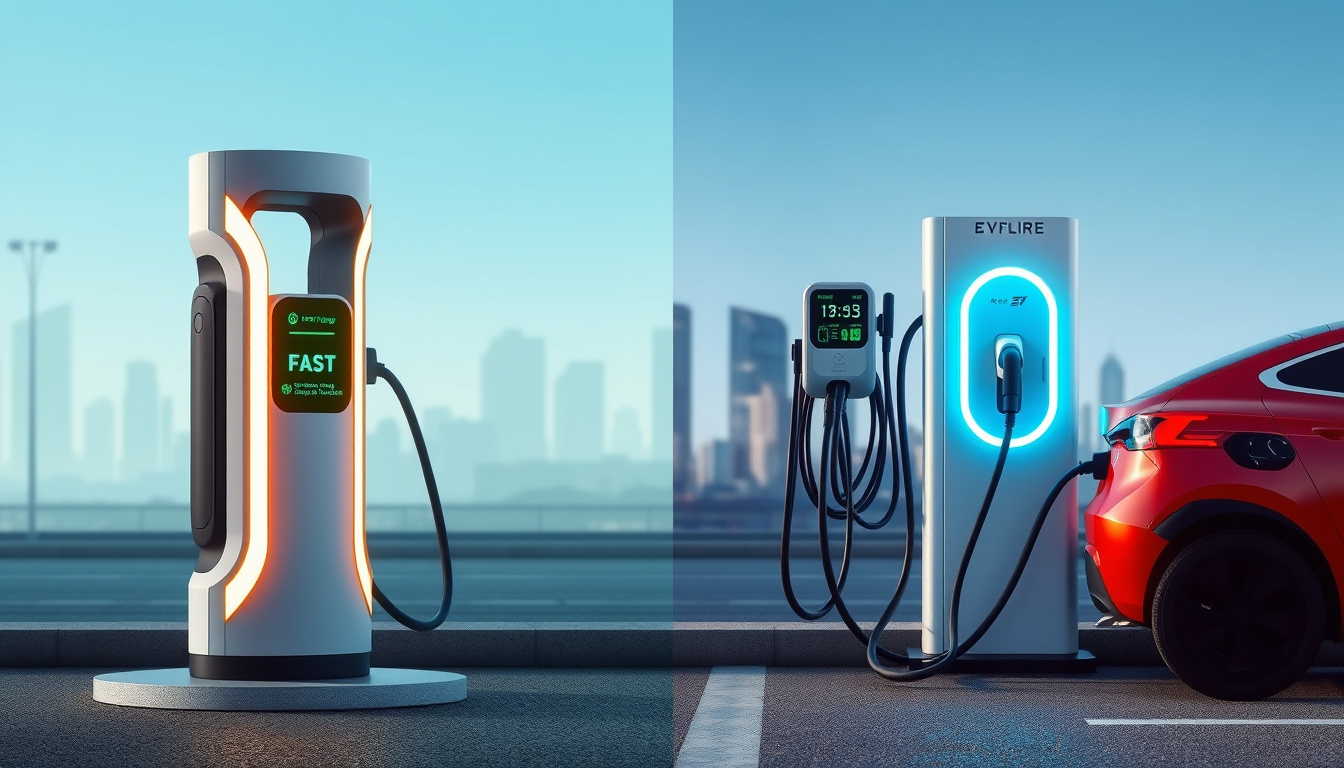
As electric vehicles (EVs) continue to gain traction in the auto industry, understanding the various charging options available is essential for potential and current EV owners.
One of the most common distinctions is between DC fast charging vs AC charging.
In this article, we will delve into the intricacies of these two charging methods, highlighting their differences, benefits, and considerations for the average EV user.
Whether you’re a seasoned EV driver or a potential buyer looking to make an informed decision, grasping the nuances of DC fast charging and AC charging will empower you to optimize your EV experience.
Key Takeaways
- AC charging uses alternating current and is typically slower than DC charging.
- DC fast charging delivers direct current for quicker charging times, ideal for long trips.
- Charging speed can vary significantly, with DC chargers powering EVs much faster than their AC counterparts.
- Cost and accessibility of charging stations differ, affecting the choice between AC and DC charging.
- Understanding these differences helps electric vehicle owners make informed charging decisions.
Understanding Electric Vehicle Charging Basics
Understanding the differences between DC fast charging vs AC charging is crucial for anyone considering the transition to electric vehicles (EVs).
DC fast charging delivers power directly to the vehicle’s battery, providing a rapid charge that can replenish up to 80% of the battery capacity in as little as 30 minutes, making it a popular choice for long trips or when quick charging is needed.
On the other hand, AC charging operates at a slower rate, using the vehicle’s onboard charger to convert the AC power from the grid into DC power stored in the battery.
This method typically takes several hours to fully charge an EV, which is more suited for overnight or home charging scenarios.
Understanding these two charging methods helps EV owners optimize their charging practices and enhance their driving experience.
What is AC Charging?
AC charging, or Alternating Current charging, is a widely used method for powering electric vehicles (EVs) and hybrid cars by converting the electrical energy from the grid.
Unlike DC fast charging, where Direct Current is used to deliver power to the vehicle’s battery quickly, AC charging operates at slower rates, typically ranging from
3.7 kW to 22 kW.
This charging method is ideal for overnight home charging or locations where the vehicle can be parked for a longer duration, such as workplaces or public parking lots.
While DC fast charging provides rapid refueling for drivers on the go, AC charging is often more accessible and cost-effective, making it an essential component of the EV charging infrastructure.
Understanding the differences between DC fast charging vs AC charging is essential for EV owners to effectively plan their charging needs.
‘The future is electric. The challenge is to find ways to harness that energy most effectively, which includes understanding the different charging technologies available.’ – Unknown
What is DC Fast Charging?
DC Fast Charging is a high-powered vehicle charging technology designed to significantly reduce the time it takes to replenish an electric vehicle’s battery.
Unlike AC charging, which typically converts alternating current to battery-compatible direct current within the vehicle, DC fast charging bypasses the onboard charger entirely.
This allows for more efficient energy delivery directly to the battery, enabling the possibility of charging an electric vehicle up to 80% in as little as 30 minutes.
While AC charging is commonly used for overnight home charging due to its compatibility with standard electrical outlets, the need for faster and more powerful charging solutions has led to the widespread implementation of DC fast charging stations on highways and in urban areas.
Understanding the differences between DC fast charging vs AC charging is crucial for electric vehicle owners, as it can impact driving range, convenience, and the overall charging experience.
Key Differences Between AC and DC Charging
When considering electric vehicle (EV) charging, understanding the differences between DC fast charging vs AC charging is crucial for optimizing your charging experience.
DC fast charging, as the name suggests, delivers a direct current to the vehicle’s battery, allowing for significantly quicker charging times—typically adding around 100 miles of range in just 30 minutes.
This is particularly beneficial for long-distance travel or when time is of the essence.
In contrast, AC charging operates via alternating current, which is the standard form of electricity supplied through household outlets and many public charging stations.
While AC charging is generally more accessible and widely available, it tends to be slower, with charging times ranging from several hours to overnight, depending on the power output and battery capacity.
Ultimately, the choice between DC fast charging vs AC charging will depend on your specific driving needs, charging infrastructure access, and how quickly you need to replenish your battery.
Charging Speed: How Do They Compare?
When exploring the differences between DC fast charging and AC charging, it’s essential to understand their impact on electric vehicle (EV) performance and convenience.
DC fast charging is designed to deliver a high voltage charge directly to the battery, allowing for rapid replenishment of energy—typically enabling an EV to charge up to 80% in just 30 minutes.
This makes DC fast charging an ideal option for long trips or busy lifestyles where time efficiency is crucial.
In contrast, AC charging delivers electricity at a lower voltage and typically requires more time to achieve a full charge; it often takes several hours to complete a full charge, making it more suitable for overnight charging at home or during prolonged stops.
While both methods play vital roles in supporting EV infrastructure, understanding the nuances of DC fast charging vs AC charging can help users maximize their driving experience and choose the right charging solution based on their needs.
Cost and Accessibility of Charging Options
When considering the cost and accessibility of charging options for electric vehicles (EVs), it’s essential to understand the differences between DC fast charging and AC charging.
DC fast charging provides a significant advantage for those needing a quick turnaround; it can charge an EV to about 80% in just 30 minutes or less, making it a popular choice for long-distance travel.
However, this speed comes at a higher cost, often charging drivers a premium for the convenience of rapid charging.
On the other hand, AC charging, typically found in home charging stations and public Level 2 chargers, is generally more affordable.
Though it takes longer to charge an EV—usually around 4 to 8 hours for a full charge—it is more widely accessible, especially in residential areas.
Ultimately, the choice between DC fast charging vs AC charging depends on the user’s driving habits, distance, and budget, but both options play crucial roles in the growing EV infrastructure.
Best Practices for Electric Vehicle Owners
As electric vehicle (EV) ownership continues to rise, understanding the nuances of charging methods is essential for maximizing performance and efficiency.
One key aspect to consider is the difference between DC fast charging vs AC charging.
DC fast charging delivers a higher voltage direct current, enabling rapid charging that can replenish an EV’s battery to about 80% in as little as 30 minutes.
This is particularly beneficial for long road trips or when quick power restoration is crucial.
In contrast, AC charging, which typically comes from Level 1 or Level 2 home chargers, is more suitable for overnight charging or prolonged periods where immediate turnaround isn’t necessary.
AC charging is generally slower but can be more convenient and cost-effective for daily charging routines.
For optimal electric vehicle ownership, it’s important to utilize DC fast charging sparingly, reserving it for urgent needs, while relying on AC charging for regular use.
By integrating both charging methods, EV owners can enhance their vehicle’s longevity and maintain a high level of efficiency.
DC Fast Charging vs AC Charging: What Every EV Driver Needs to Know in 2026
If you’ve ever stood at a charging station wondering why one plug adds 200 miles in 20 minutes while another takes all night, you’ve stumbled into the heart of EV infrastructure: the difference between DC fast charging and AC charging. It’s not just about speed—it’s about how electricity actually gets into your battery, and which method suits your lifestyle.
AC charging (used at home and most public Level 2 stations) sends alternating current to your car, where an onboard charger converts it to DC to fill the battery. It’s gentle, affordable, and perfect for overnight top-ups. DC fast charging, on the other hand, skips that step—delivering direct current straight to the battery via an external, high-power unit. That’s why it’s 10–20x faster, but also harder on the battery if overused.
Understanding this isn’t just tech trivia—it shapes how you plan trips, choose an EV, and even protect your battery’s lifespan. For deeper context, explore how electric vehicle charging fits into daily ownership.
How AC Charging Works: The Everyday Hero
AC charging is the backbone of EV ownership—quiet, reliable, and cost-effective. Most drivers use Level 2 AC chargers (240V), which deliver 7–11 kW to add 25–40 miles of range per hour. That’s more than enough for a typical 30–40 mile daily commute.
Every EV has an onboard charger (usually 7–11 kW) that handles the AC-to-DC conversion. That’s why plugging your Hyundai Kona Electric or MG ZS EV into a 19.2 kW public AC station won’t make it charge faster—the car itself limits the speed.
Pros of AC charging:
✅ Lower cost (chargers start at $400)
✅ Gentler on battery (less heat = longer life)
✅ Ideal for home, office, or overnight use
✅ Universal compatibility (Type 2 or J1772 plugs)
For most daily drivers, AC is all you’ll ever need—especially if you’ve got a home EV charger installed.
DC Fast Charging: The Road Trip Rocket
When time is tight and miles are long, DC fast charging (DCFC) is your lifeline. Found along highways and in urban hubs, these stations deliver 50–350 kW directly to the battery—bypassing the car’s onboard charger entirely. That means a 10–80% charge in 15–40 minutes, depending on your EV’s capabilities.
But not all EVs accept the same speeds. The Audi Q4 e-tron maxes out at 125 kW, while the BYD Seal can take 150 kW. Tesla’s Model X uses its proprietary network (now opening via NACS adapters). And remember: charging slows dramatically after 80% to protect the battery—a key reason “100% in 20 minutes” is a myth.
DCFC downsides:
❌ Higher cost per kWh (often $0.40–$0.80)
❌ Can accelerate EV battery degradation if used daily
❌ Requires CCS, CHAdeMO, or NACS connector (check compatibility!)
❌ Uptime isn’t always 100%—use apps like PlugShare to verify
🛣️ Planning a long drive in your Fisker Ocean? Know your DCFC limits before you go.
AC vs DC Charging: Quick Comparison
Feature | AC Charging (Level 2) | DC Fast Charging |
|---|---|---|
Power Range | 3.7 kW – 19.2 kW | 50 kW – 350 kW |
Typical Use | Home, workplace, shopping | Highways, road trips |
Charge Time (0–80%) | 4–10 hours | 15–40 minutes |
Connector Types | J1772 (US), Type 2 (EU) | CCS, NACS, CHAdeMO |
Battery Impact | Low stress | Moderate stress (use sparingly) |
Best For | Daily top-ups | Emergency/long-distance |
Final Thoughts
AC charging is your daily driver; DC fast charging is your weekend adventure partner. Use AC for 90% of your charging to maximize battery health and save money. Reserve DCFC for road trips or when you’re truly in a pinch. And always check your car’s maximum charge acceptance rate—because no station can charge faster than your EV allows.
🌍 Curious how all this fits into sustainability? See how electric vehicles save the environment—even when using grid-powered DC stations.
Frequently Asked Questions
What are the main differences between DC Fast Charging and AC Charging?
The main differences between DC Fast Charging and AC Charging lie in the charging speed and technology used.
DC Fast Charging delivers high voltage direct current directly to the vehicle, allowing for much faster charging times compared to AC Charging, which uses alternating current and typically requires the vehicle’s onboard charger to convert it to DC.
How long does it take to charge an electric vehicle using DC Fast Charging compared to AC Charging?
DC Fast Charging can charge an electric vehicle to 80% in about 30 minutes, depending on the vehicle and charger capacity.
In contrast, AC Charging can take several hours, typically between 4 to 10 hours, depending on the charging station’s power output and the vehicle’s battery size.
Are there additional costs associated with DC Fast Charging?
Yes, DC Fast Charging is generally more expensive than AC Charging due to the advanced technology and infrastructure required.
Charging costs can vary by location and provider, so it’s advisable to check local pricing before use.
Where can I typically find DC Fast Charging stations compared to AC Charging stations?
DC Fast Charging stations are often located along major highways and in urban areas for quick top-ups during long trips, while AC Charging stations are more commonly found in residential areas, workplaces, and shopping centers.
What should electric vehicle owners consider when choosing between DC Fast Charging and AC Charging?
Electric vehicle owners should consider factors such as their charging needs, schedule, and the availability of charging stations.
For long trips, DC Fast Charging is ideal, while for daily use and overnight charging, AC Charging is usually more convenient and cost-effective.